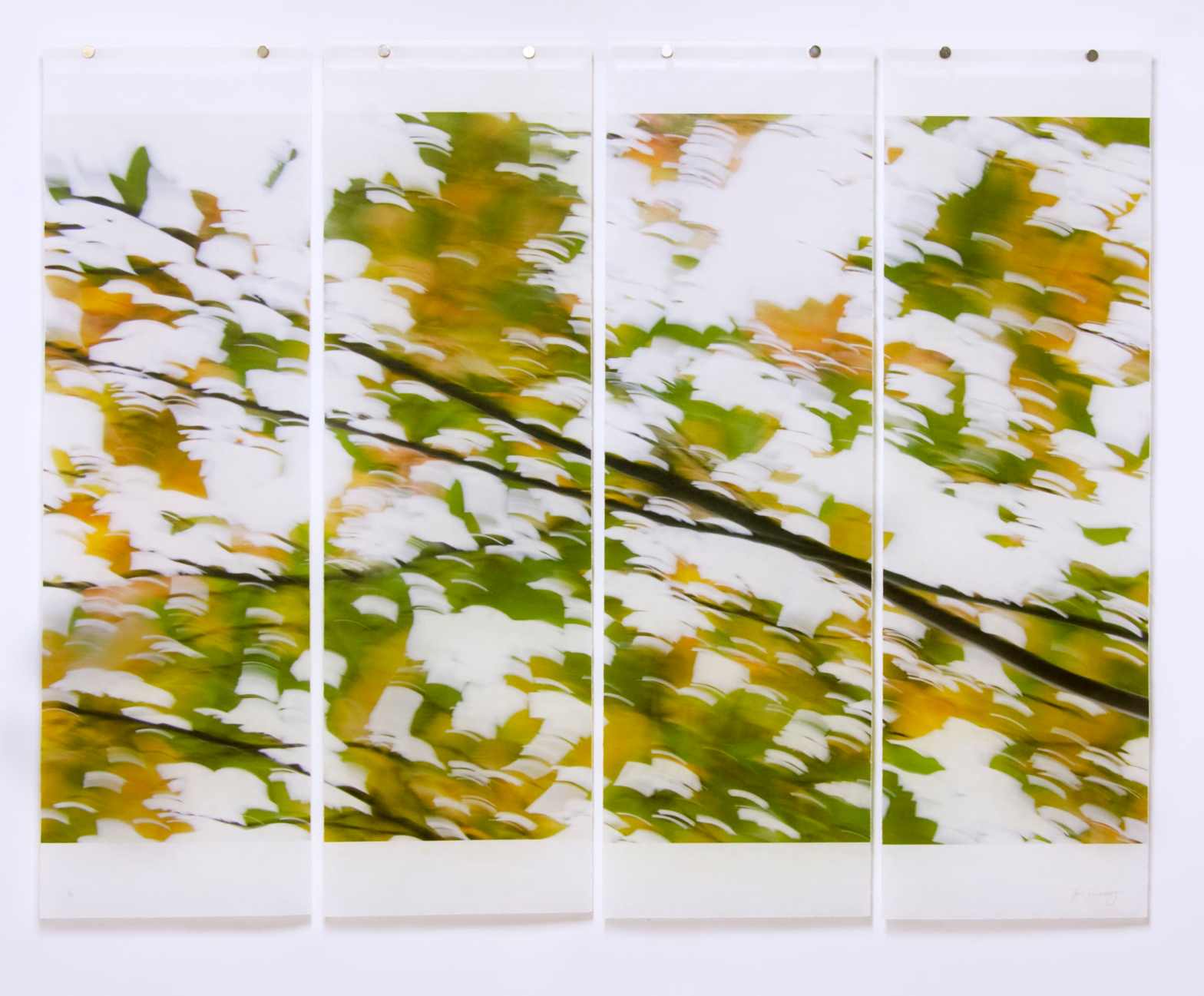
The work of Jeri Eisenberg captures ethereal, fleeting moments in nature. Her photographs are printed on handmade paper, with an encaustic wax medium embedded into the kozo. The combination of modern and ancient techniques is not unharmonious; instead, the pairing is beautiful and delicate. The work flutters off the gallery wall, reminiscent of the movement of leaves in the wind.
Do Ho Suh, Apartment A, Unit 2, Corridor and Staircase, 348 West 22nd Street, New York, NY 10011, USA (detail), 2011–2014. Polyester fabric and stainless steel tubes.
Hilldur Bjarnadóttir, Urban Color Palette, Reykjavik, 2010 Woven wool plant dyed in weeds from downtown Reykjavik.
Topaz ring stone, 1st century B.C.–3rd century A.D. Roman, Late Republican or Imperial Beryl, yellow, or Topaz, The Metropolitan Museum of ArtGold phiale (libation bowl)4th–3rd century B.C. The Metropolitan Museum of Art
Yellow has been used in artworks for centuries. It brings to mind warmth, sunlight, happiness, but also represents power and wealth. Yellow is one of the most common colors in nature, from flowers and lichens to stones and earth pigments. Artist have been compelled to make work in this color for millennia, and it’s no wonder as to why. Yellow’s bright, cheery warmth draws the eye, and captivates us.
Yellow is a versatile color, evoking many different reactions from the viewer: whether a meditation on life as with Wolfgang Laib’s pollen square, or a shockingly lemon-colored fabric bathroom that leaves the viewer slightly unsettled. Gold and topaz artifacts convey power and strength, interacting with light to hold the eye. Mamma Andersson’s yellow room painting conveys a certain sense of comfort and homeyness. Yellow has the ability to shift and convey different meanings, depending on the setting and interactions with the viewer. This bright color will always be a striking aid to artists.
Dorothy Cross is an Irish artist who draws inspiration from many sources, but is deeply inspired by Connemara, her home. The sea inspires much of her work; sharks play a particular role in her practice.
As an artist, her practice has a more curatorial approach. She incorporates the use of found objects. Cross’ work deals with themes of time, and often cause the viewer to meditate on the dialogue between nature and humanity. Her pieces carry a primal and sacred presence. The fascination with sharks also recalls this notion of deep time; as ancient creatures, they have been on this planet for millions of years. In Shark Heart Submarine, pictured above, the viewer is confronted with many different avenues of history: an antique artist easel, a sleek submarine, and the knowledge that a shark heart is nestled somewhere within. Time flows through the piece, cycling back, both modern and contemporary and yet still ancient. Her unique practice places her at the forefront of Irish art today.
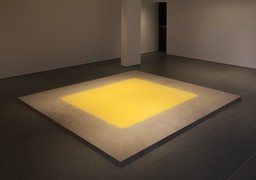
Wolfgang Laib’s pollen installations instill a sense of awe and reflection. Carefully collecting pollen by hand, the amassing of materials can span the course of years. The meticulous collection, sifting, and display all have a meditative quality, typical of Laib’s practice, which is often influenced by the spirituality of eastern religions. Most (if not all) of Laib’s work features elemental materials. The pollen holds heavy symbolism of life, creation, and continuation. Though laden with meaning, the yellow square is almost stunning in its simplicity. It evokes a mellow calm and quiet.
This installation was carried out at MOMA in 2013.
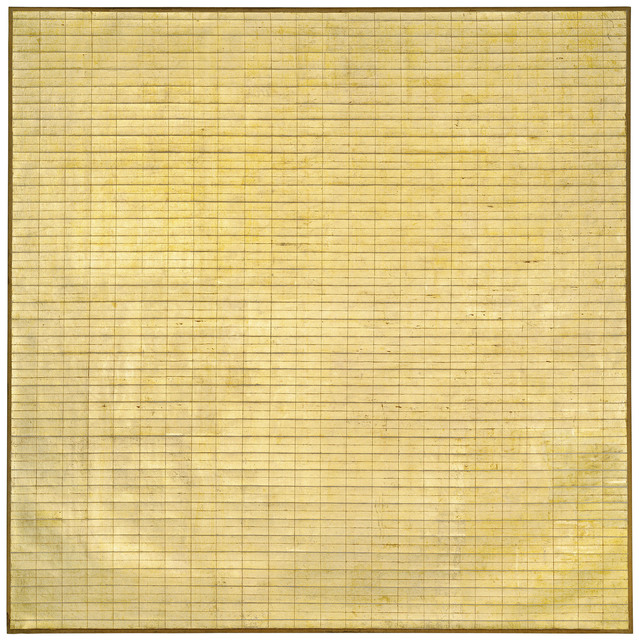
Agnes Martin’s Friendship is a stunning piece, and is unusual when compared to her other works. Though the grid pattern is typical for Martin, who’s work focuses on serenity and balance, the majority of her practice tend to lean towards pastels and blues, and more muted pastel tones. The monumental gold piece has a very different impact, bringing to mind the role that gold has played in the art world since antiquity; from icons and relics to golden adornments, it has been a color associated with spirituality and power for millennia.
The warm surface of gold casts a buttery yellow light, softly illuminating the floor. Perhaps this effect is exactly what Martin had intended when she titled the piece Friendship. Light and spirituality often have adjoining roles in art, offering the viewer a quiet and contemplative space.





 brittany baldwin